RESEARCH & COLLABORATION
Better aquarium care starts with learning together.
We welcome conversations with university students, marine biologists, aquatic scientists and research teams working towards healthier, more stable aquatic environments.
AN OPEN INVITATION
Sharing practical experience. Learning from research.
Green Leaf Aquatics is developing an in-store and home aquarium water-testing platform. Our longer-term hope is that real-world testing observations can help researchers investigate questions that matter to aquarists and aquatic animals.
We're interested in contributing where our work can genuinely help, whether that's supporting a student project, discussing a research question or exploring ways to collect useful water-quality observations.
We are at an early stage. We don't claim existing university partnerships or offer unrestricted access to customer information.
WHO WE'D LOVE TO HEAR FROM
Students and research teams
- University and postgraduate students
- Marine biologists and aquaculture researchers
- Water chemistry and environmental scientists
- Microbiologists and aquatic health researchers
- Commercial and public aquarium specialists
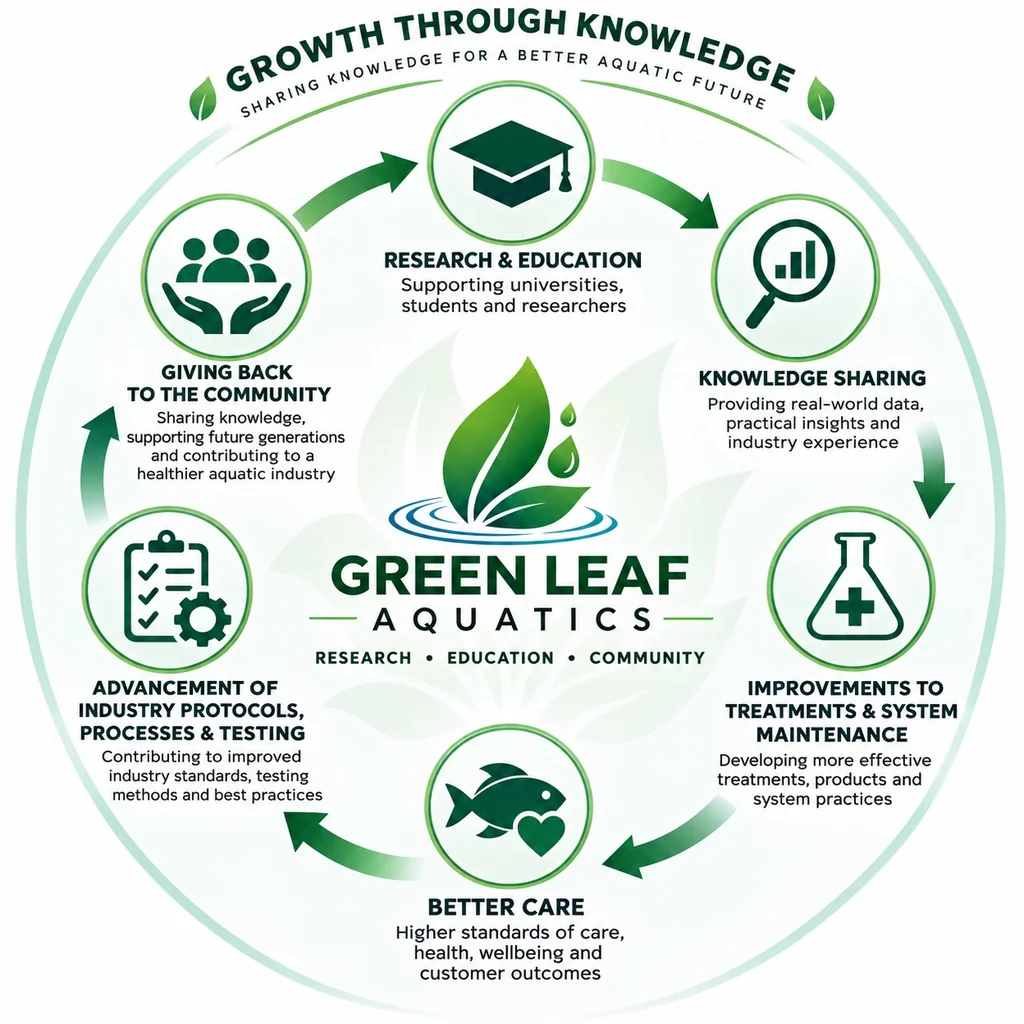
OUR FOUNDATIONS · GROWTH THROUGH KNOWLEDGE
Sharing what we learn. Learning from others.
Improving aquarium testing, treatment accuracy and aquatic welfare is not a new addition to Green Leaf Aquatics. It is one of the reasons the platform is being developed.
We believe meaningful progress happens when practical experience and scientific research are shared openly and questioned carefully. We want to help students, researchers and aquarium keepers learn from real-world observations, and to learn from their work in return.
From more accurate home water testing to safer dosing and more stable aquatic environments, we hope to contribute where our experience can be useful. We are still building that foundation, one step at a time.
Growth through knowledge and the sharing of knowledge.
POSSIBLE AREAS OF RESEARCH
Practical questions worth investigating.
We're interested in helping researchers explore better methods and healthier outcomes, rather than promoting any particular manufacturer's products.
Improving accuracy, consistency and ease of use in home and professional aquarium testing.
Examining treatment calculations, dosing intervals and the difference between predicted and measured outcomes.
Understanding changes in pH, alkalinity, hardness, nutrients and other water-quality indicators.
Investigating links between changing water conditions, aquatic stress and disease risks.
Evaluating reagent chemistry, test-kit reliability, method validation and affordable technologies.
Supporting stable, naturalistic conditions in home, commercial, marine and research aquariums.
REAL-WORLD AQUARIUM OBSERVATIONS
What could we learn between water tests?
Home testing alongside professional store testing could help reveal how aquarium water changes over time, including treatment responses and longer-term stability.
We are exploring a future voluntary research program, where stores and their customers would make their own decisions about participation. Optional details could include test-kit method and brand, reagent expiry date, measured aquarium temperature, treatment history and tank photographs.
We'd welcome guidance from researchers on how to collect this information in ways that are scientifically useful.
POTENTIAL OBSERVATIONS
From testing to understanding
- Repeated home and store water-quality results
- Testing method and reagent information
- Aquarium profiles and measured water temperature
- Treatment records and follow-up measurements
- Optional aquarium photographs
Future research participation would require informed consent. Names, addresses and identifying store information would be excluded from research exports; linked records and photos would be reviewed for re-identification risk.
UNIVERSITIES · STUDENTS · RESEARCHERS
Have an aquatic research question?
Tell us what you're investigating. We'd be glad to discuss whether we could contribute something useful.